Process interview demo Video
Building permits: submission to certificate of occupancy
A plans examiner maps multi-department review, resubmit loops, inspections, and final sign-off.
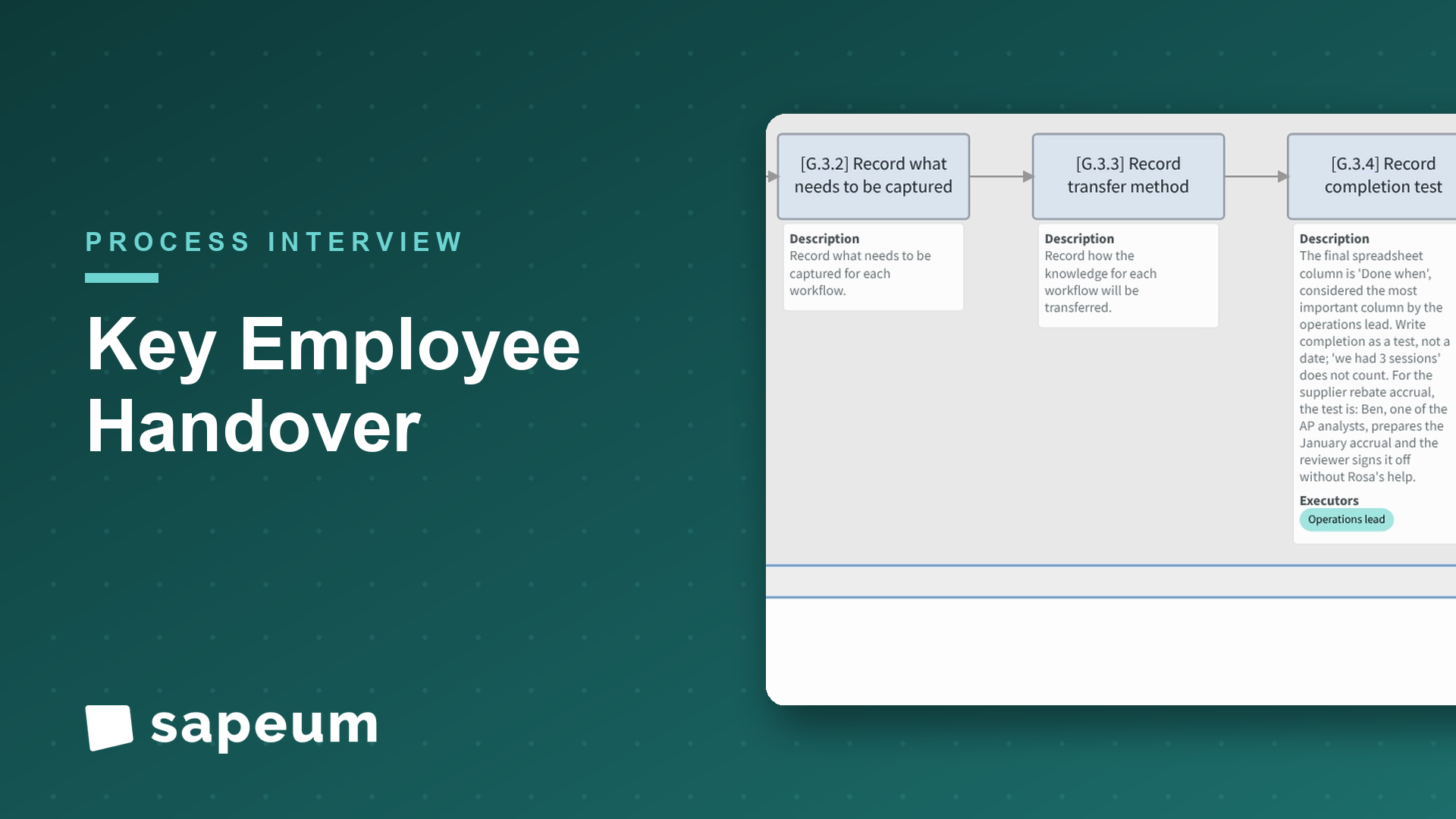
WatchAn operations manager at an insurer explains how she runs a knowledge transfer when someone who owns critical work gives notice, using a departing accounts payable lead whose quarterly rebate accrual nobody else had ever run. Sapeum draws the process map while she talks: the plan, the capture sessions on real cases, the successor's test run, the last-day checks, and the branches for retirements, garden leave and people who have already gone.
Interviewer: Quick note before we start. I'm recording this, and I've got Sapeum open alongside us, drawing the process map on screen as you talk. Which is a little meta, given the topic. That okay?
Manager: Totally fine. It's more or less how we do it now anyway.
Interviewer: So you run operations at an insurer, and you've been through a lot of these handovers. Where does one start?
Manager: Somebody who owns important work gives notice. Usually it's a resignation with two weeks, sometimes a retirement we've known about for a year. The last one I ran was Rosa, our accounts payable lead. Really good at her job. And she was the only person who had ever run our quarterly supplier rebate accrual. Nobody else had touched it.
Interviewer: Ouch. What's the first thing you do?
Manager: Figure out what kind of notice we're dealing with, because the plan changes. Two weeks is the normal case. A planned retirement gives you months. Then there's garden leave, where they're joining a competitor and get sent home, so you can still talk to them but they've lost system access. And sometimes they're already gone before anyone thought about it. Rosa gave two weeks, so let's stay with her.
Interviewer: Okay. Two weeks, day one.
Manager: The first two days go on writing the plan. I sit down with the person and we list every workflow they own. What people miss is the quarterly and year-end work. If you only watch what somebody does in their last two weeks, you'll never see the rebate accrual, because it runs at quarter end. Rosa's was next due January 6th. That one would have hurt.
Interviewer: What does the plan look like on paper?
Manager: A spreadsheet, one row per workflow. Each row says how often it runs and when it's next due. Priority, so high, medium or low, and why. The accrual was high, because only she'd ever done it and it feeds our quarter-end numbers. Then who's receiving it, and what systems, access and authority they'll need. Which controls it supports. For the accrual, that's our quarter-end accruals review. What exists today, which in Rosa's case was a spreadsheet with notes from 2022. Better than nothing. What we need to capture, and how we'll transfer it.
Interviewer: That's a lot of columns.
Manager: It is. The last one is the one I care about, though. "Done when." And I write it as a test, not a date. "We had three sessions" doesn't count. For the accrual it read: Ben prepares the January accrual and the reviewer signs it off without Rosa's help.
Interviewer: Who's Ben?
Manager: One of our AP analysts. Which gets to the next question I always ask. Is there a named successor? With Rosa, no. We were still hiring a new lead, so Ben covered. When there's no successor, a manager or a teammate picks it up, and the draft has to be good enough for someone brand new to follow later. Once the new hire starts, you debrief with them the first few times they hit an exception. That's usually where the missing decisions turn up.
Interviewer: Access sounds like somewhere this could stall.
Manager: Oh, it does. I put the requests in during those first two days. Ben needed the ERP preparer role for accrual entries and a login for the supplier portal. That goes through our normal access process with a segregation of duties check, same as any other request, and approval limits get re-delegated under our delegation of authority. If your successor can't log in when the sessions start, you lose days you don't have.
Interviewer: Then comes the actual knowledge part.
Manager: Days three to eight. We do one session for each high-priority workflow, and we walk through a recent real case. Not a general "so how does this work." For quarterly work we use last cycle's files, so Rosa opened last quarter's accrual workbook and took us through it supplier by supplier.
Interviewer: What are you listening for?
Manager: The steps, the decisions, the exceptions, and who she calls. Which suppliers have tiered rebates. What she does when a supplier disputes the volumes. Who at each supplier actually confirms the numbers, because it's never the person in the vendor file.
Interviewer: And who's writing all that down?
Manager: We used to put a note-taker in the room, and then somebody wrote it up afterwards. Now it looks like this. She talks through the case, Sapeum draws the process map while she talks, and then she corrects the draft. Rosa moved a couple of steps and added an exception we'd missed entirely, a supplier whose rebate tier resets in the middle of the year.
Interviewer: Any ground rules for those sessions?
Manager: Two. Get consent before you record anything. And if the cases have personal data in them, use closed files or redacted ones. In AP that's mostly bank details and the odd employee reimbursement.
Interviewer: What if the person doesn't want to help? They're leaving, after all.
Manager: It happens. They're still employed, so the handover is part of their job, and I say that plainly. Then I keep the sessions short. One workflow and one real case each. Nobody wants a "write down everything you know" marathon in their last week.
Interviewer: So now you've got maps. Are you done?
Manager: No, and that's where people stop too early. Days nine and ten are for proving it. The successor runs a real case while the departing person watches and corrects. Ben redid last quarter's accrual from the source files, and Rosa checked his result. Done means he ran it on a real case and the reviewer signed off. If it doesn't pass, he runs it again if there's time. If there isn't, someone gets named as the owner of what's left.
Interviewer: And the last day?
Manager: Mostly checks. I make sure the handover document is complete: access, contacts, recurring deadlines, open items, where the files live, known workarounds, and the process maps from the sessions. Then I go down the plan row by row. Every row has either passed its test or has a named owner for whatever's left. Then the controls side. We update the control owner and performer in our control inventory and let the SOX team know. Her access comes off that same day.
Interviewer: Let's go back to the other kinds of notice. Retirement first?
Manager: Retirement is the best case, and also the most to transfer, because it's someone with maybe thirty years in the role. You plan over months. In the first couple of months you inventory everything and write the plan, like before. Through the middle months the successor prepares the work and the retiree reviews it, within their own authority. Then in the final quarter you flip it, so the successor does the work and the retiree only reviews. And if you're hoping to bring them back as a consultant, talk to HR before you plan on it. Retirement plans can restrict rehiring.
Interviewer: Garden leave?
Manager: You can usually still reach them during the notice period, they just can't get into anything. So we run the walkthroughs by phone, and I prepare printouts or screenshots ahead of time so they've got something to point at.
Interviewer: And when they're already gone?
Manager: Then you work from what they left behind. Tickets, emails, spreadsheets, the files from past cycles, and the people upstream and downstream of the work. You map it from that and write down what you don't know yet. If they left on good terms, a short paid call to check the draft can be worth it. HR and legal set up a consulting agreement with confidentiality terms, and they get no system access.
Interviewer: Last one. What do people get wrong about handovers?
Manager: They book a long exit interview, record it, and call it a handover. A recording still has to be turned into steps and decisions, and checked with the person before they leave. What works is smaller and more concrete. A real case, a map they've corrected, and a successor who has actually run it with a reviewer's sign-off. And start with the work that won't come up during the notice period, because that's the stuff you otherwise find out about in January.
Interviewer: That's a good place to stop. Thanks, Dana.
Manager: Anytime.
Keep exploring
A plans examiner maps multi-department review, resubmit loops, inspections, and final sign-off.
WatchA treasury lead maps cash forecasting across funds and entities, and where it breaks down.
WatchA brokerage account manager walks through COI issuance while the process maps itself; including the automation nobody had scoped.
WatchEverything you just saw runs on real workshops, not staged demos. Bring a process of yours and see for yourself.