Process interview demo Video
Building permits: submission to certificate of occupancy
A plans examiner maps multi-department review, resubmit loops, inspections, and final sign-off.
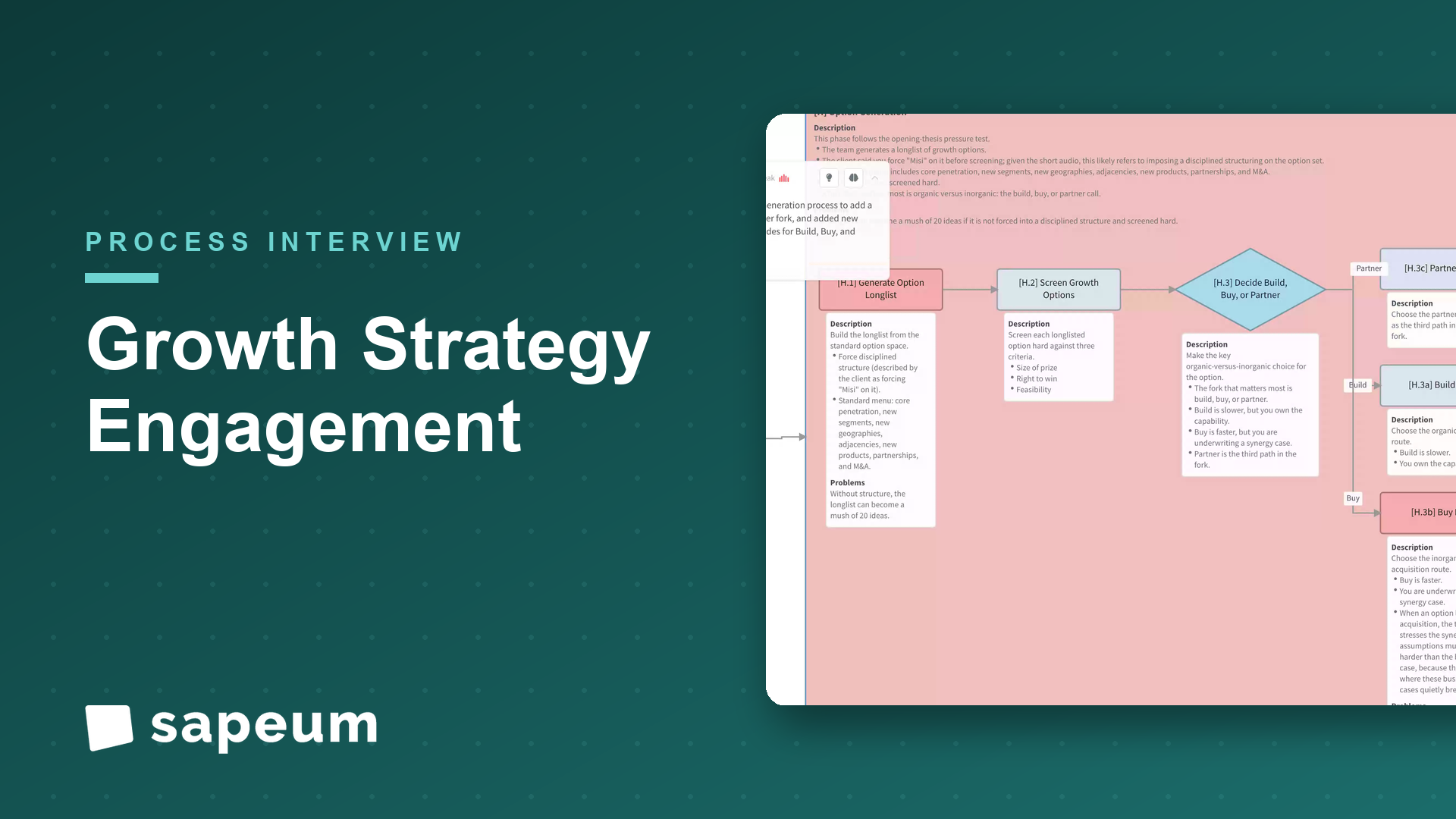
WatchA partner in a management consultancy's Strategy practice narrates how a growth engagement really runs: scoping the question, diagnosing where growth comes from today, sizing the market, testing the hypothesis, building the options and the business case, and carrying it into an executable plan. Along the way they name the real bottlenecks, data access, the day-one-answer trap, and adoption, with parallels to pricing strategy and org design.
Interviewer: Thanks for making the time. Let's skip the textbook and get into how one of these actually runs. Take me from origination through handoff on a growth engagement, and I'm more interested in where it gets stuck than where it goes smoothly.
Partner: Good, because that's where the real story is. So origination first. These rarely arrive as a clean RFP. More often it's a relationship, a CEO I've known calls and says the top line has flattened and the board is asking why. Or it's a competitive bake-off where we're one of three firms pitching. Or we go in proactive with a point of view they didn't ask for. My job at that stage isn't to solve it, it's to qualify it. Is there a real decision attached, is there a budget, is there a sponsor with the authority to act on the answer. An unfunded problem with no owner is the most expensive thing you can chase, and most partners have been burned by one.
Interviewer: And the scoping. How hard do you commit to a hypothesis before you've staffed it?
Partner: Hard, deliberately. We're hypothesis-driven, so the proposal already carries a day-one answer, our best guess at where the growth is and how they capture it, structured as an issue tree. The risk, and this is the first real trap, is that the day-one answer quietly becomes the day-ninety answer. You write it to focus the work, not to defend it. A team that spends twelve weeks assembling evidence for the partner's opening guess has produced advocacy, not analysis. So I scope tight on the question and stay deliberately loose on the answer.
Interviewer: How do you keep the team honest about that in practice?
Partner: You design the workplan to try to kill the hypothesis, not confirm it. Falsification tests up front. If the thesis is "win in mid-market," the first analysis is the one most likely to disprove it, not the deck-ready exhibit. And you watch for the tell, when an analyst starts discarding data points that don't fit the story. That's the same discipline whether it's a growth case or a pricing case. On pricing you see people anchor on a target price and then reverse-engineer a willingness-to-pay curve to support it. Same failure mode, different chart.
Interviewer: Let's get into mobilization. What actually bites in the first two weeks?
Partner: Data access, every time. We staff the team, set governance with the sponsor, agree the steerco cadence, and the very first thing we fire off is the data and interview request list. And that list is almost always the critical path for the whole engagement. The client promises transaction-level data in three days and it shows up in three weeks, in twelve inconsistent extracts, with revenue cuts that don't reconcile to their own board pack. So the genuine early bottleneck is rarely analytical, it's getting clean, granular data out of the client's systems and stitching it into something you can actually segment.
Interviewer: That's the diagnostic, then. Where do you start cutting it?
Partner: We baseline the current state before we say a word about the future. Decompose the revenue by segment, product, geography, channel, then the unit economics underneath it, and the trajectory. The point is to isolate where growth actually comes from today and what's decelerating. And very often the sharpest insight of the entire project is sitting in their own data, a segment quietly losing share, a cohort whose retention is rolling off. Something they half-knew and had never seen decomposed cleanly. Getting to that depends entirely on the granularity of the data, which loops right back to the access problem.
Interviewer: Then the market work. Primary research is the obvious time sink. How do you decide when it's worth it?
Partner: That's a real trade-off you make with the sponsor, eyes open. We size the market, segment demand, map the competitive set, and do voice-of-customer work, because the client's own read on why people buy is usually flattering and a little dated. The question is whether you commission fresh primary research, which is richer but adds weeks and real cost, or you lean on secondary and the client's existing data. Primary is the long pole. If a conjoint or a proper customer survey is on the critical path, that single decision can set the timeline of the whole case. It's the same calculus in a pricing study, where you essentially cannot get defensible willingness-to-pay without primary work, so you build the plan around it from day one.
Interviewer: And the inside view. The capability assessment is the step I see teams shortchange.
Partner: Constantly, because it's the least glamorous. But a growth thesis the client can't execute is just an expensive opinion. So we assess the real assets and constraints. Cost position, brand permission, channel access, tech stack, and talent. The strategy has to fit the company they actually are, not the one on the org chart. And this is exactly where growth work bleeds into org design, because nine times out of ten the binding constraint isn't the market, it's that the operating model can't support the move. You tell a functional organization to go win three new customer segments and there's no one accountable for a segment. The structure can't hold the strategy.
Interviewer: So you reach the point of testing the hypothesis against the evidence. What happens when it doesn't hold?
Partner: You reframe, and you treat that as the process working, not failing. There's usually a defined moment where we pressure-test the opening thesis against everything we've gathered, and sometimes the evidence just kills it. When that happens you reframe the question and loop back into the relevant analysis with a better one. The pathology to avoid is the team that's fallen in love with the day-one answer and is now bending the data to it. I'd rather take the reframe in week six than defend a wrong thesis to a board in week twelve.
Interviewer: Onto option generation. How do you keep the long list from becoming a mush of twenty ideas?
Partner: You force MECE on it and then you screen hard. The menu is the standard space, core penetration, new segments, new geographies, adjacencies, new products, partnerships, M&A. You screen each on size of prize, right to win, and feasibility. The fork that matters most is organic versus inorganic, the build, buy, or partner call. Build is slower but you own the capability. Buy is faster but you're underwriting a synergy case, and synergies are systematically overestimated, revenue synergies especially. So when an option leans on acquisition we stress the synergy assumptions much harder than the base case, because that's where these business cases quietly break.
Interviewer: The modeling. How much weight does the business case really carry versus the narrative?
Partner: Both have to be airtight, but they do different jobs. We narrow to two or three coherent options, each a distinct where-to-play and how-to-win, and we build the full case for each. Revenue build, investment required, margin trajectory, risk, over a sensible horizon. The board is going to ask exactly how much, by when, and what has to be true, so the model has to survive that interrogation. But the model isn't the persuasion, it's the support. I've watched analytically flawless cases die because the storyline didn't land, and weaker cases win because the narrative gave the executives the conviction to act.
Interviewer: Prioritization. Portfolio or single bet?
Partner: Almost always a portfolio, sequenced. Some near-term moves that build momentum and self-fund, a couple of bigger bets with a longer payback. We lay it out as a phased roadmap with the resourcing implied, so it reads as a path they can actually walk rather than a wish list. The sequencing is a genuine design choice, not an afterthought, because the early wins are what buy you the political capital to fund the big bets.
Interviewer: Which brings in the client. You're not going dark for twelve weeks and then unveiling it.
Partner: Never, and this is the step that most determines whether the work lands. We socialize the emerging answer through the steerco at planned checkpoints, and that's as much about reading the politics as sharpening the logic. An analytically perfect strategy the executive team doesn't believe in is dead on arrival. So when the steerco pushes back, or a constraint lands mid-stream, a budget freeze, a CFO change, we rework. The discipline is that the final readout should contain no surprises for anyone who matters. If a steering committee member is shocked in the final meeting, you've already failed, the work just hasn't caught up to it yet.
Interviewer: So by synthesis, the answer is more or less pre-agreed.
Partner: Largely, and here's the part people find counterintuitive. By that stage the answer is rarely the hard part. The synthesis pulls it into one storyline, where to play, how to win, what it's worth, what it costs. But two competent teams looking at the same evidence usually converge. The intellectual answer is maybe the easy twenty percent. The craft is everything wrapped around it.
Interviewer: And you carry it into implementation rather than stopping at the recommendation.
Partner: You have to, or it's a deck on a shelf. We translate the strategy into an operating model and an implementation plan. The initiatives, named owners, the governance, the capabilities to build, and the value-tracking metrics, so there's a way to know months later whether the prize is actually showing up. Then the final readout to the executive team or board, get the decision committed, and hand off. And that handoff is frequently the start of the next chapter, implementation support, or a follow-on. The results, and the new questions the work surfaces, tend to seed the next engagement.
Interviewer: Last one. Across all of this, growth, pricing, org design, what's the thing people consistently get wrong?
Partner: They fixate on the answer. The clever insight, the elegant framework, the number nobody else spotted. Early in your career that's what you chase because it's the satisfying part. But the answer is the easy twenty percent. The hard eighty is everything around it. Framing the right question, because a precise answer to the wrong question is worthless. Getting the data, because most of these engagements are gated by access and granularity long before they're gated by intellect. And building conviction as you go so the client owns the strategy instead of receiving it, then making it executable against their real constraints. It's the same lesson in org design, where the new structure is trivial to draw and brutal to actually land because you're moving people and power. The graveyard is full of correct recommendations nobody adopted. Being right is cheap. Getting an organization to move is the whole job.
Interviewer: That's a great place to end it. Really helpful, thank you.
Partner: My pleasure. It looks like analysis from the outside and it's mostly about evidence and people once you're inside it, so it's good to lay out how it really runs.
Keep exploring
A plans examiner maps multi-department review, resubmit loops, inspections, and final sign-off.
WatchA treasury lead maps cash forecasting across funds and entities, and where it breaks down.
WatchA brokerage account manager walks through COI issuance while the process maps itself; including the automation nobody had scoped.
WatchEverything you just saw runs on real workshops, not staged demos. Bring a process of yours and see for yourself.
Book a demo