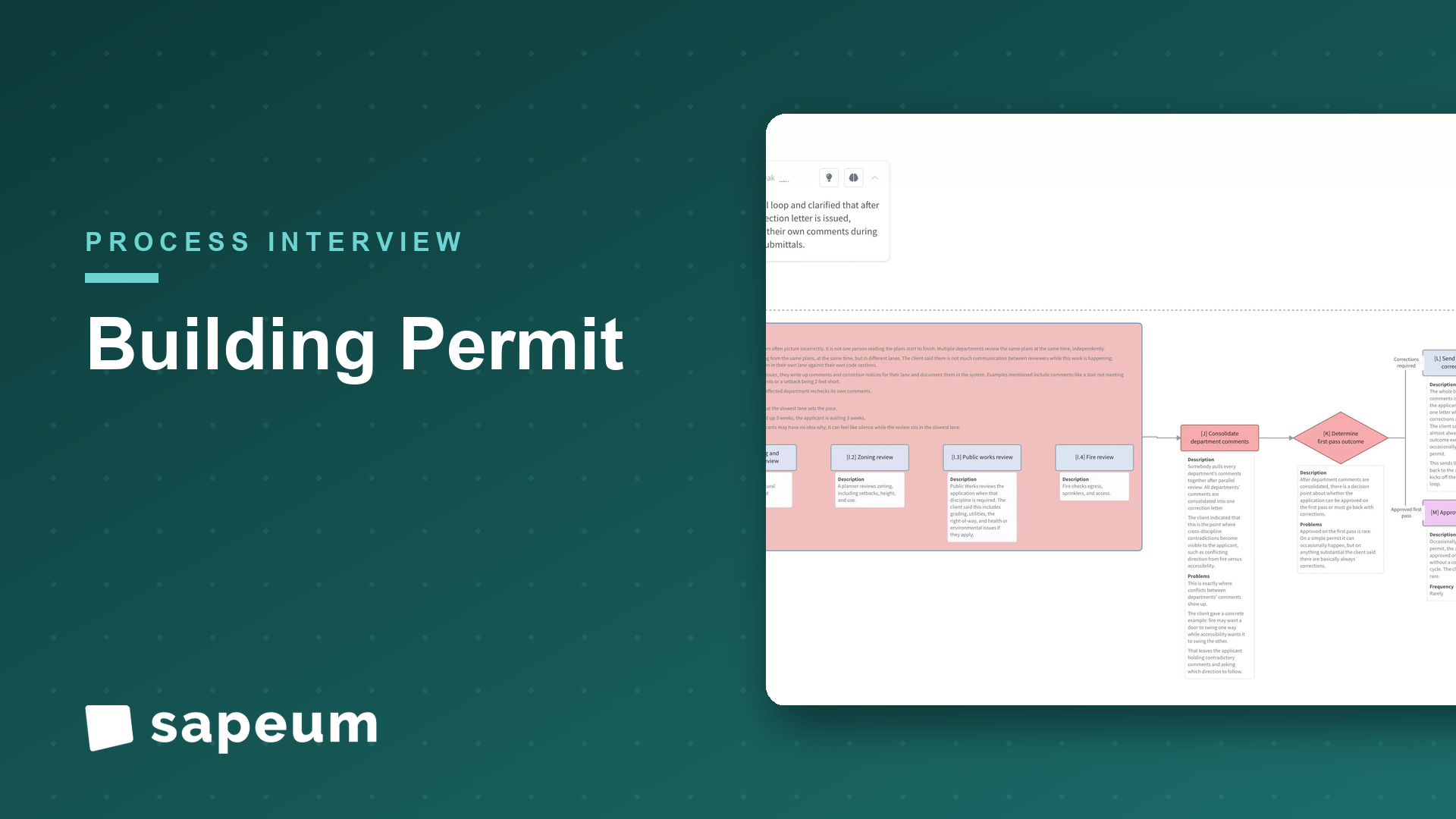
Process interview demo Video
Building permits: submission to certificate of occupancy
A plans examiner maps multi-department review, resubmit loops, inspections, and final sign-off.
WatchA head of deal operations at a private-capital firm walks through the deal pipeline as the infrastructure under the investment committee: sourcing, screening, where information is stored, the data brought in at each stage, the IC decision and close, and the institutional memory that should compound; with candid nods to where data scatters across tools.
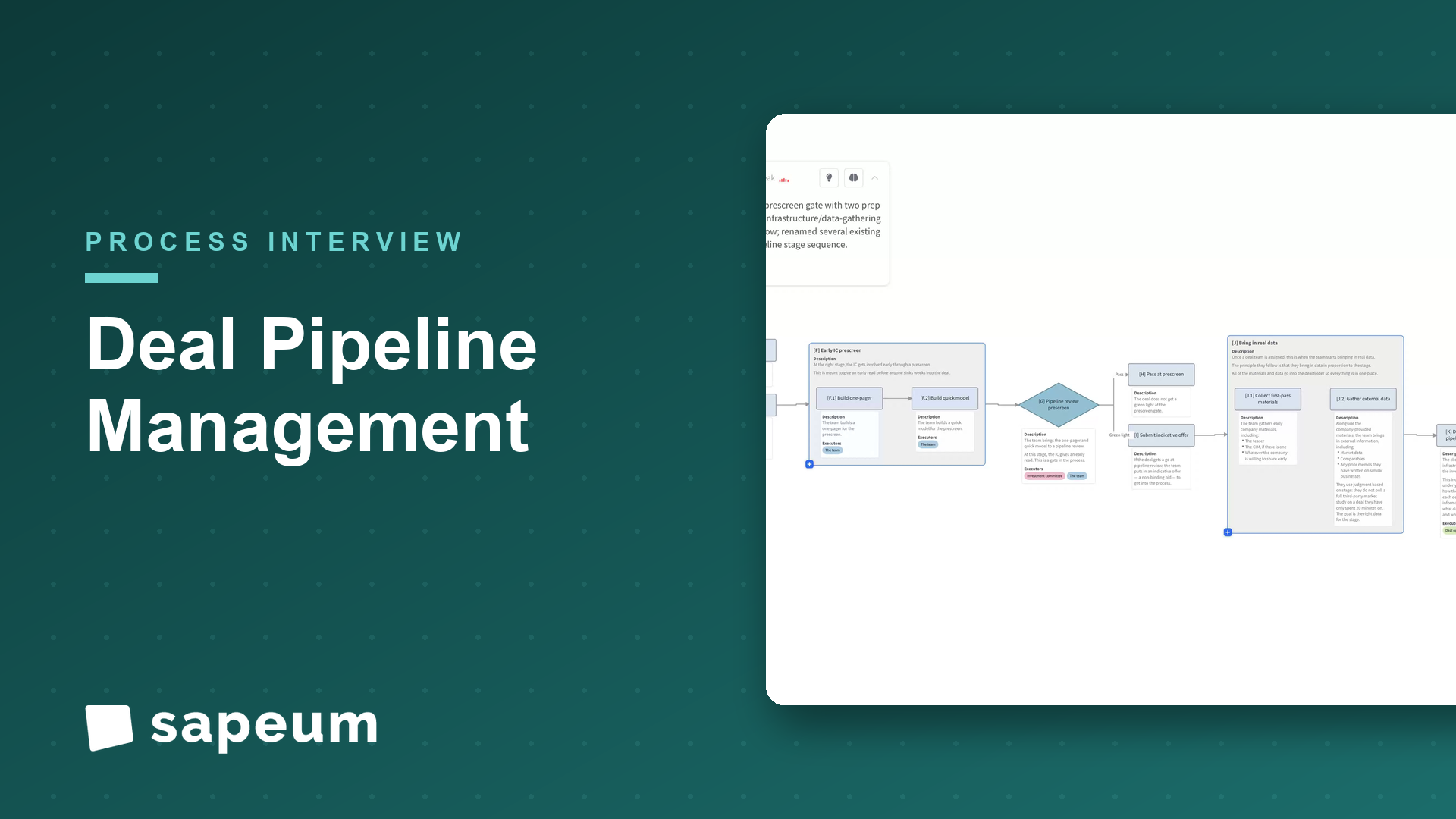
Interviewer: Thanks for doing this. I want to understand how your deal pipeline actually works, the machinery under the investment committee, the way you'd explain it to someone new running deal ops. Wherever you want to start.
DealOps: Sure. So the way I think about my job, the investment committee makes the decisions, but my team runs the infrastructure that feeds them. And really there are three questions underneath everything. How are we looking at each deal, where does the information live, and what data do we bring in, and when. Get those right and the IC can move fast with confidence. Get them wrong and you're redoing work and making decisions on thin information. Let me start at sourcing.
Interviewer: Where do deals come from?
DealOps: All over. Bankers and intermediaries send us processes, we do proprietary outreach, we get inbound, deals come in through existing relationships. And the first rule is everything gets logged in the deal CRM at first touch. Every single look. Even the ones we're going to pass on in five minutes. Because the log itself is the asset. It's how we know what we've seen.
Interviewer: So the moment a deal shows up, it's in the system.
DealOps: It's in the system, and we tag it. Sector, geography, source, sponsor. And we dedup. That's a step people skip and then regret. Have we seen this company before? Did we look at it two years ago and pass? Because if so, I don't want the team starting from a blank page. I want them pulling the old file, the old model, why we passed. That prior work is gold, and it's the thing that most often gets lost.
Interviewer: Okay, it's logged and deduped. Then what?
DealOps: Then a quick screen against our mandate. Is it the right size, sector, geography, return profile. Most deals die right here, and that's fine, but we log why we passed, because that reason is data too. The ones that survive get a deal team, a lead and an analyst, and that's when we start bringing in real data.
Interviewer: What data, at that point?
DealOps: First-pass materials. The teaser, the CIM if there is one, whatever the company's willing to share early. And alongside it, external stuff. Market data, comparables, any prior memos we've written on similar businesses. All of it goes into the deal folder so it's in one place. The principle we follow is that we bring in data in proportion to the stage. We don't pull a full third-party market study on a deal we've spent twenty minutes on. Right data, right stage.
Interviewer: And then the IC gets involved early?
DealOps: Yeah, a pre-screen. The team builds a one-pager and a quick model and brings it to a pipeline review, so the IC gives an early read before anyone sinks weeks into it. That's a gate. Green-light to keep going, or pass. If it's a go, we put in an indicative offer, a non-binding bid, to get into the process. If we're not selected, we log the outcome and drop it, but again, we keep the record.
Interviewer: Say you get into the process.
DealOps: Now it gets heavy. We kick off structured diligence, financial, commercial, legal, tax, and we ingest the full data room. This is where the real volume of data lands, and where we bring in third-party advisors. And the infrastructure job here is diligence tracking. Every workstream, every finding, every open item, all the documents and notes centralized. Because you've got a dozen people across the firm and outside it all generating information at once, and if it's scattered across email and personal folders, the memo at the end is going to miss things.
Interviewer: And the memo is what goes to the committee.
DealOps: The investment memo, right. We synthesize all that diligence into one document. The thesis, the risks, the returns, the structure. That goes to the IC, they debate it, and they decide. Approve, approve with conditions, decline, or send it back for more work. If it goes back, we loop on diligence and come again. If it's approved, we move into final negotiation and definitive docs, confirm the financing and structure, and there's a final sign-off before we sign and fund.
Interviewer: And after it closes?
DealOps: We close and hand it off to portfolio monitoring, and this part's important: the deal data moves into the portfolio system, the model, the memo, the key terms, so the people managing the asset for the next several years aren't starting cold. And then the part that closes the loop, pipeline reporting. How many deals did we see, what converted, by source, our win-loss. That tells us which sources actually produce deals worth doing and which screens are working. And we keep the whole history, so the next time this company or this sector comes around, we start ahead.
Interviewer: So if you had to name the thing people get wrong about running a pipeline, what is it?
DealOps: They think the pipeline is a list of deals. A CRM with some names and stages. But that's just the surface. The real thing is the discipline of capturing every look, and the right data at every stage, so two things happen. The IC always has the right information at the right gate to decide quickly, and the firm's memory compounds instead of evaporating. The biggest hidden cost in this business is redone work and lost history. A deal dies, and six months of insight just disappears because it lived in someone's inbox. So the pipeline isn't a list. It's the firm's institutional memory and its decision engine. And honestly, ours lives across a CRM, data rooms, spreadsheets, and a lot of email, so keeping it all connected is the constant challenge, and where I think there's real opportunity.
Interviewer: That's a great place to end it. Really helpful, thank you.
DealOps: Of course, happy to. It's the kind of thing that's invisible when it works, so it's nice to actually describe it.
Keep exploring
A plans examiner maps multi-department review, resubmit loops, inspections, and final sign-off.
Watch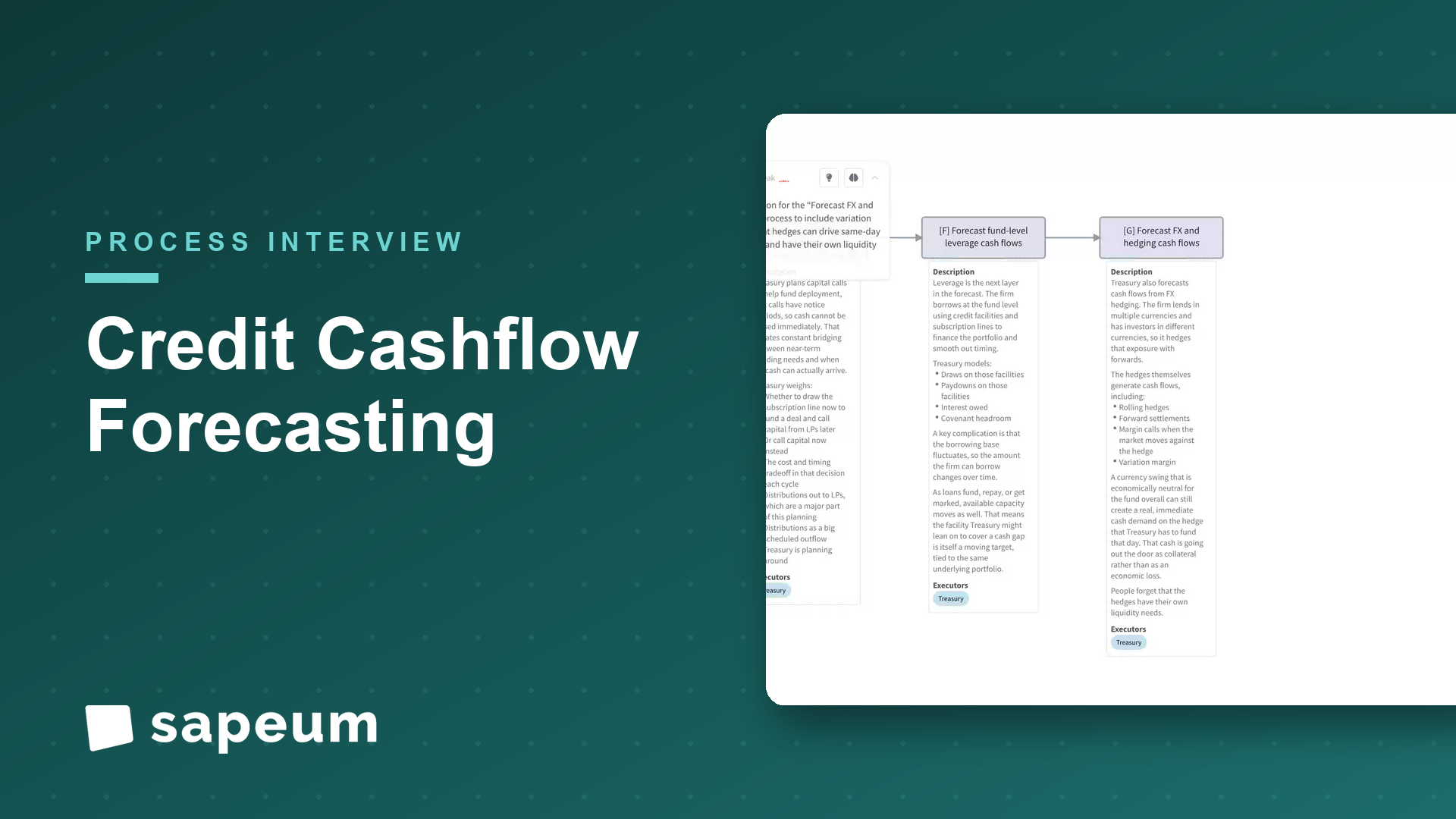
A treasury lead maps cash forecasting across funds and entities, and where it breaks down.
Watch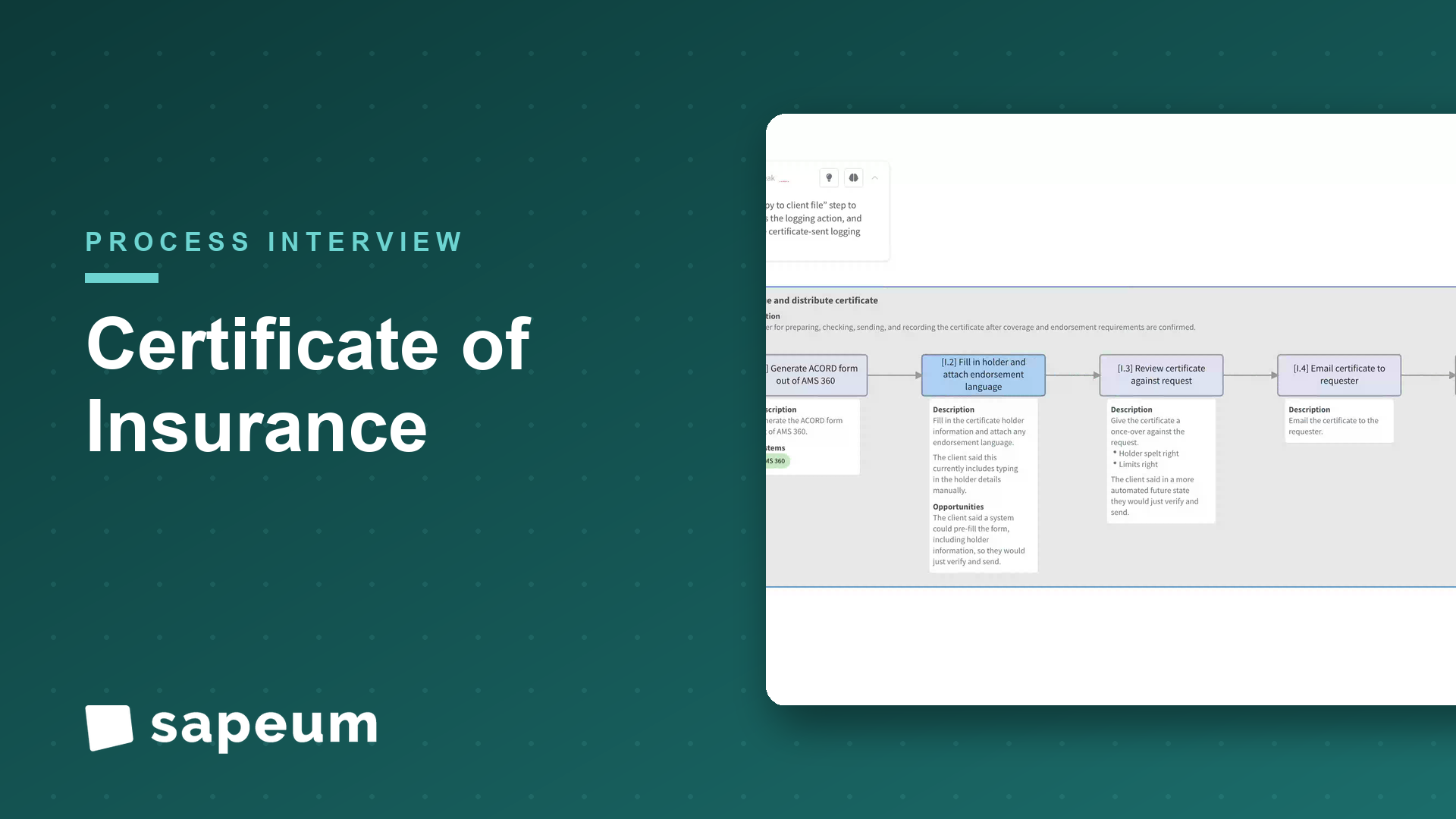
A brokerage account manager walks through COI issuance while the process maps itself; including the automation nobody had scoped.
WatchEverything you just saw runs on real workshops, not staged demos. Bring a process of yours and see for yourself.
Request Access